


27 February 2026
RISO – The Unsung Early-Warning Hero of RATMON Leak Monitoring
Some measurements arrive with fireworks and fanfare (TDR, I’m looking at you). And then there’s RISO; quiet, steady, almost modest. But don’t be fooled. When it comes to catching leaks early, RISO is often the first whisper that something’s not quite right.
Let’s dig into it in a way that feels more human than a datasheet, because RISO deserves a proper introduction.
So… what on earth is RISO?
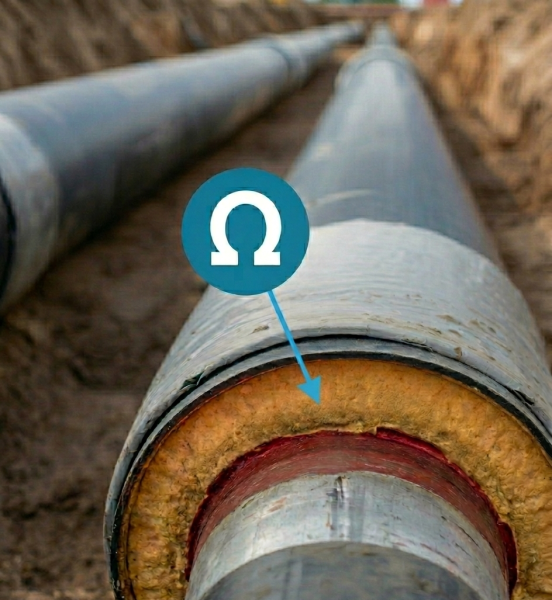
RISO (usually written as RISO, or Riso) is a measurement of insulation resistance. It’s most effective in Nordic steel pipe systems, where the steel carrier pipe provides a stable electrical reference; in polymer pipe systems, RISO measurements are significantly more difficult to obtain. Think of it as a score for “how dry and intact is this whole system?”. If your leak-detection wires are the two rails of a railway track, RISO tells you how well the sleepers (the insulation) are keeping them apart.
A high number means dry, healthy and nothing to worry about. A falling number means that something’s sneaking in; water, contamination, degradation, etc. A very low number, well… something’s touching that should not be touching.
It’s measured in megaohms (MΩ), kiloohms (kΩ) and ohms (Ω). These are units of electrical resistance that are a way of describing, “This material is very insulating with low conductivity, all the way through to, no insulation and highly conductive.”
Why the RATMON system even cares about RISO
RISO is a whole-system indicator. While a TDR will point at a specific fault, for example, at 137 metres down the line, RISO is the quiet overseer that mutters, “Hey, something’s wrong somewhere.”
RISO gives you:
- Early warnings before insulation is fully wet
- Trend visibility (“this is getting worse every day… why?”)
- A single health metric for the entire loop
- Continuous monitoring even before a TDR investigation is carried out
It’s like the difference between noticing your house is feeling damp vs. seeing the exact wall stain where the leak originates.
What affects RISO?
Several things can nudge RISO readings up or down:
- Moisture inside the pipe insulation – the biggest culprit.
- Ageing insulation – nothing lasts forever.
- Contamination – salts, dirt, or corrosion products.
- Mechanical damage – crushed jacket, pinched wire, dodgy splice.
- Full-blown water bridge – wires get effectively shorted.
If you plotted RISO over time, a healthy system is a flat, boring line. A system heading toward trouble develops a gentle but unmistakable downward slope.
How RISO behaves when things start going wrong
Here’s the kind of behaviour RATMON engineers watch for:
- Slow moisture ingress
RISO starts drifting downward. Not a cliff—more like a slide.
This often means water is creeping into the insulation but hasn’t reached the conductors yet.
- Rapid decrease
Could be a sudden wet event or physical damage. An actual leak will normally generate readings in the tens of kiloohms. This is the “you need to go look at the pipe” situation.
- RISO measured in ohms (rather than megaohms)
This means the conductor is being bridged. Usually by water. Sometimes a short. Never a good day.
- RISO fluctuating unpredictably
Often linked to environmental factors affecting the insulation layer or the integrity of the pipe casing. Events such as temperature cycling, where high temperature media cause the pipe to expand and contract, resulting in gaps between the steel and insulation. If moisture is present, the physical shifts change the electrical contact and the RISO value jumps.
Where TDR and RISO team up
Think of RISO as the sentinel and TDR as the detective.
- RISO: “Something’s wrong—somewhere—go look.”
- TDR: “Aha! It’s 52.3 metres down the pipe, and here’s the shape of the fault.”
And that pairing is precisely why RATMON uses them side by side, where possible. RISO catches the earliest hint that moisture is present; TDR shows you where and what type of problem you’re facing.
How RATMON uses RISO in real installations
- Tracking insulation health across steel pre-insulated pipe networks
- Finding early signs of water inside heat network jackets
- Picking up partial shorts before they become hard faults
- Triggering alarms when resistance falls below safe thresholds
RATMON treats RISO as a first-line diagnostic. If RISO looks off, you know something’s brewing.
Real-world examples
The creeping damp patch
A contractor notices RISO has been sliding from >200 MΩ to 5 MΩ over two weeks. No reflections on the TDR yet. A small leak is forming, insulation dampening slowly from a micro-crack.
The overnight drop
A repair team gets an alarm at 3 a.m. RISO plummeted from >200 MΩ to ~100 kΩ. The TDR shows a harsh downward dip at 67 m. Someone hit the pipe during unrelated works.
The split casing
RISO fluctuates daily, from 180 to 140 to 170 MΩ. The pipe runs through a chamber and has a split in the casing. The readings swing between damp and dry depending on the weather. Not a leak but not a healthy environment and it could lead to detrimental damage.
Why RISO matters more than people expect
Because it spots the quiet problems.
Leaks don’t suddenly go from “perfectly fine” to “Niagara Falls.” They start with tiny damp events – insulation picking up moisture molecule by molecule. RISO sees that. It gives you time. Time to plan a repair. Time to investigate. Time to be proactive, rather than reactive and avoid an expensive emergency.
If TDR is the glamorous, graph-drawing wizard, RISO is the steady heartbeat monitor. You need both.
The mV indicator
Ratmon engineers will frequently also analyse the galvanic voltage millivolt (mV) reading associated with a RISO value. The expectation is that water ingress from rain, or other environmental sources of moisture, will cause elevated millivolt readings. A service pipe leak will be very high (in the hundreds of millivolts) but may also have negative polarity. This can be due to the corrosion and scaling inhibitors that are added to the water. The behaviour is a useful way to differentiate between environmental moisture ingress versus an actual service pipe leak.
Quick RISO cheat sheet
| RISO Behaviour | What It Means | Likely Scenario |
| High & stable | All good | Dry insulation, healthy system |
| Gradual decline | Moisture forming | Tiny ingress, early leak, ageing jacket |
| Sudden drop | Something serious | Water bridge, damage, conductor contact |
| Measured in ohms | Fault condition | Short or soaked section |
| Small Fluctuations | Environmental effects | Condensation cycles, temperature swings |
Final thoughts
RISO doesn’t get the spotlight, but it should. In RATMON systems, it’s often the first reliable sign that trouble is stirring somewhere inside a pipe you can’t see. And when paired with TDR, it forms a remarkably powerful duo – one that spots problems early and helps locate them before they escalate.
This is just one of the types of measurement performed by Ratmon products that support RISO measurement, such as MegaLoc-1 and the RAT Combo that saves time, money, and, frankly, a lot of headaches.
Recent News

4 February 2026
Time Domain Reflectometry (TDR) – A Down-to-Earth Guide for RATMON Leak Detection
3 February 2026
Protecting Critical Infrastructure with RATMON’s Leak Detection Solutions for Data Centres and District Heating
2 January 2026
Understanding the Nordic Two-Wire Leak Detection System
7 November 2025
Reviving Alarm Systems in Legacy Buried Heat Networks